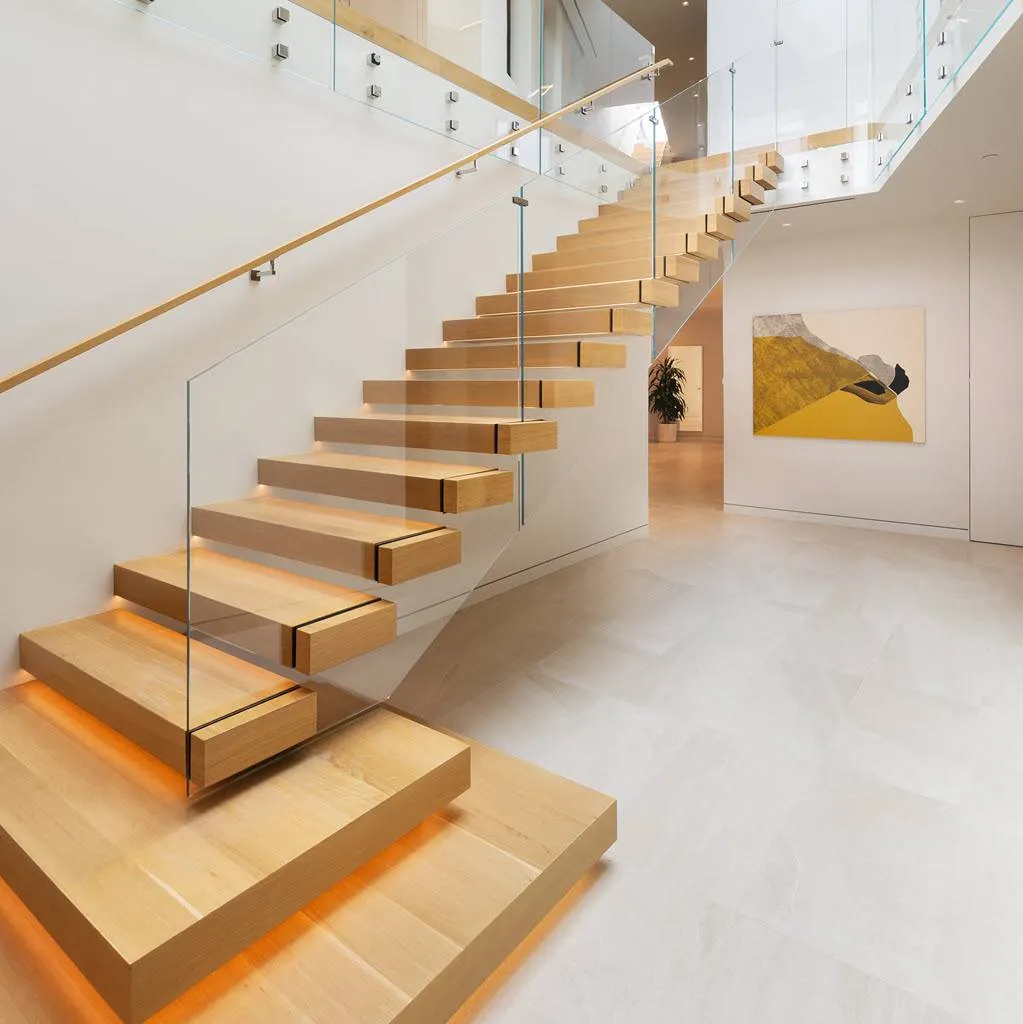
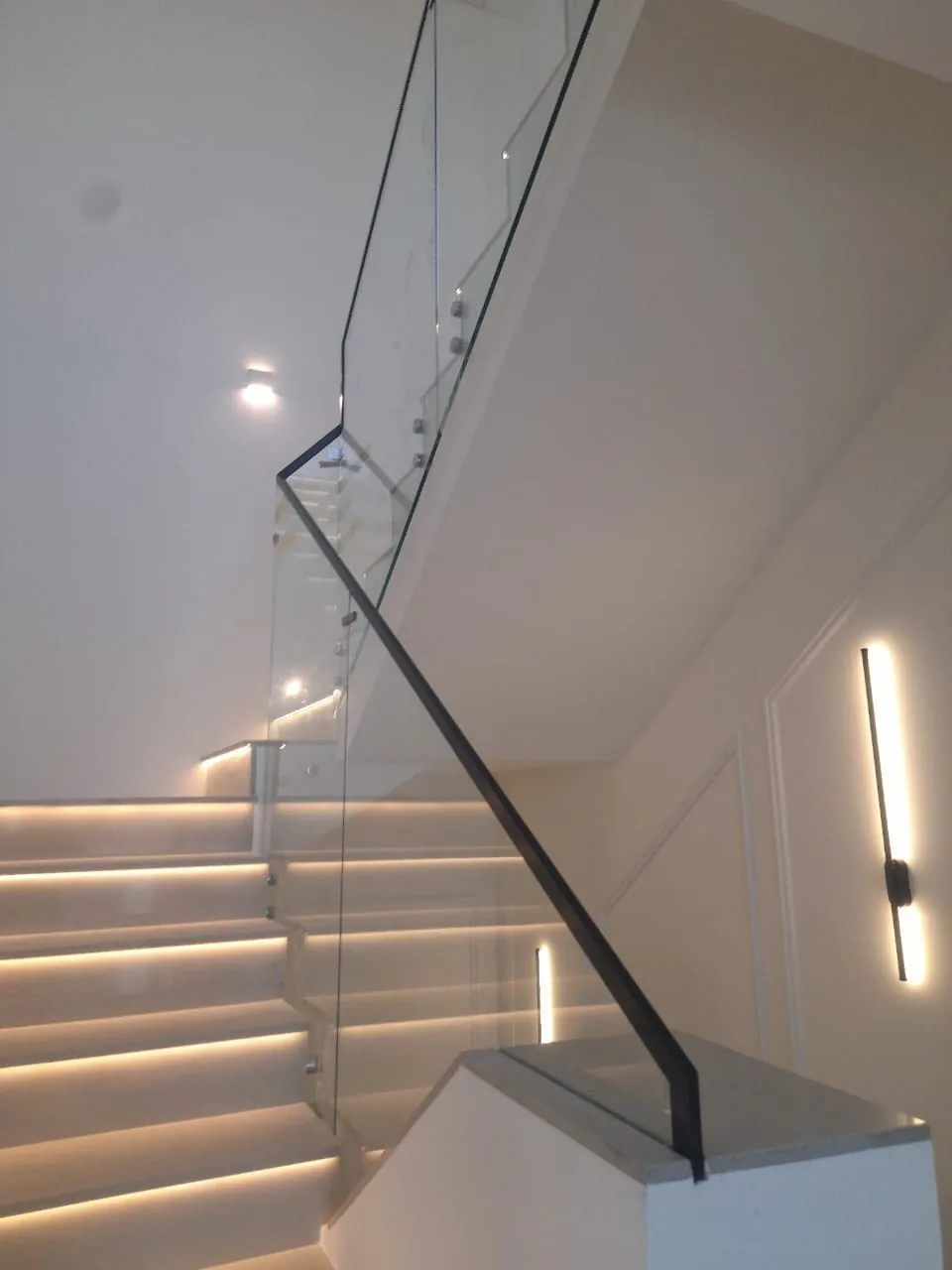
Most glass balustrade enquiries start with the same question, and most websites answer it with a single number that turns out to be meaningless once anyone measures the actual staircase. This guide gives the ranges the UAE market is genuinely working to in 2026, explains which system sits where inside them, and sets out what actually moves a quotation up or down, so you can read two competing numbers and understand why they differ.
The Going Rate in Dubai
Across the UAE market, glass balustrade and railing work is most commonly advertised at AED 900 to AED 2,500 per linear metre, installed. That is a wide band, and the width is the useful part of the information: it reflects genuinely different products rather than one product priced inconsistently.
Where a given system falls inside that band is fairly predictable:
- Frameless channel-fixed sits at the top of the range. The glass carries the structural load alone, so it has to be thicker, and the channel has to be set and levelled to a tight tolerance.
- Spigot and point-fixed systems land in the middle. The hardware shares the load, which allows a thinner glass build-up and a faster install.
- Post-and-clamp, semi-frameless systems sit lower again, for the same reason.
- Framed aluminium with a glass infill is usually quoted per square metre instead, commonly around AED 400 to AED 900 per square metre installed, and is the most economical route to a compliant barrier.
What Whole Projects Come To
Per-metre rates are useful for comparing systems and close to useless for budgeting, because a balustrade job is rarely a single straight run. Advertised project totals across the UAE market generally fall between AED 12,000 and AED 50,000, with a typical villa staircase or balcony run in frameless glass commonly cited at AED 15,000 to AED 30,000 including materials and installation.
The jobs that land above AED 50,000 are usually not more expensive per metre. They are longer, spread across several levels, or involve curved glass, which is a different fabrication process entirely.
The Seven Things That Actually Move the Price
Understand these and you can read any balustrade quotation properly:
- Glass specification. Toughened glass alone is cheaper than toughened-laminated. Laminated adds an interlayer that holds the panel in place if it breaks, which is why it is the right call above a certain height and around pools.
- Glass thickness. Driven by the system and the span. A frameless run needs more glass than a post-fixed one covering the same distance.
- Hardware grade. Powder-coated aluminium and 304 stainless are fine indoors. Exposed coastal and poolside work wants marine-grade 316 stainless, which costs more and lasts.
- Handrail. Whether one is included at all, and whether it is stainless, aluminium, timber, or a glass cap rail.
- Geometry. Straight runs are cheap. Curves, angled transitions, stepped staircase runs, and multi-level continuity all add fabrication and setting-out time.
- Access. An upper-floor balcony needing scaffolding or a lift costs more than a ground-floor pool edge, before any glass is priced.
- Drawings and approvals. Structural calculations and the submission pack for a developer or municipality are real work. Some quotes include them and some quietly do not.
Reading Two Quotes Side by Side
When two quotations for the same balcony differ by several thousand dirhams, the gap is almost never pure margin. It is nearly always specification. The cheaper number is commonly toughened glass where the application really calls for toughened-laminated, or 304 hardware on a seafront balcony where 316 is the sensible choice, or a price that stops at the glass and leaves the handrail, the approval drawings, and making good the substrate for you to sort out later.
Before comparing, get both contractors to confirm in writing the glass build-up in millimetres, the interlayer if laminated, the hardware grade, whether the handrail is included, and who is responsible for structural drawings and the approval submission. Once those five lines match, the numbers become genuinely comparable, and quite often they converge. Our own glass balustrade installation in Dubai itemises all five as standard, for exactly this reason.
Commonly Excluded, Worth Asking About
- Removal and disposal of an existing railing
- Making good the floor, deck, or parapet where the channel or spigots fix
- Scaffolding or access equipment above ground floor
- Structural calculations and the developer or municipality submission
- Protective or hydrophobic glass coatings
- Out-of-hours working where a community restricts noisy work to set times