ACP works very well on a UAE villa, but as a feature rather than a full wrap. It excels on flat rectilinear planes: an entrance feature, an upper-storey band, a parapet line, a carport or a boundary structure. On a villa carrying arches, mouldings and decorative detail, panel cladding fights the architecture instead of flattering it, and render or stone is the honest recommendation. Knowing which villa you have is most of the decision.
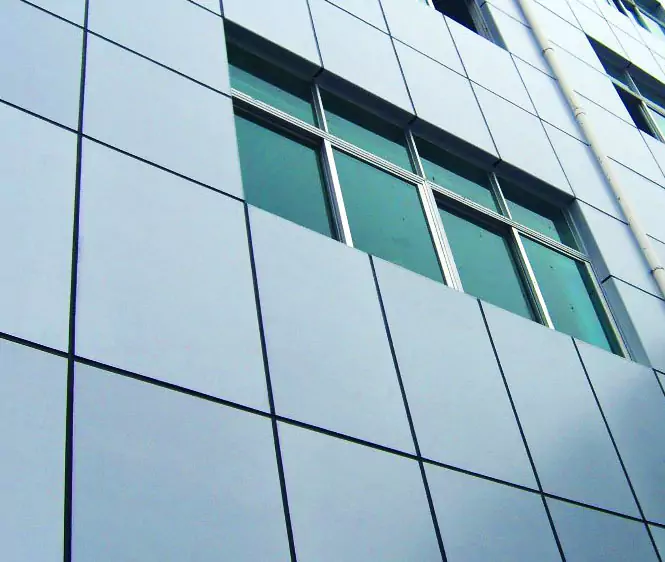
ACP suits clean flat planes and crisp corners, which is why it reads well on contemporary villa architecture.
Which Villas ACP Suits
The material has a strong visual character: flat, precise, uniform, with deliberate joint lines. That is a perfect match for the contemporary villa style built across Dubai, Sharjah and Ajman over the last fifteen years, where the architecture is already composed of clean rectangular masses. On those homes, cladding an entrance block or a first-floor band in a contrasting panel colour reads as intentional design.
It is a poor match for traditional and Mediterranean-influenced villas with curved arches, cornices, columns and textured render. ACP can be curved and can be formed around detail, but doing so is expensive and the result usually looks like a modern material apologising for being there. If a villa's charm is in its mouldings, the money is better spent restoring them.
Where It Gets Used on a Villa
- Entrance features - cladding the mass around the main door to give the entrance visual weight, often in a darker or wood-effect finish against a pale rendered body
- Upper-storey bands - wrapping a first-floor volume to break up a tall elevation horizontally
- Parapets and roof edges - tidying the top line of a villa and concealing roof plant, a common retrofit
- Carports and car shades - fascia and soffit panels, where flatness and weather resistance matter and the structure is already rectilinear
- Boundary walls and gate piers - contemporary treatment at street level that stays clean and does not need repainting
- Column casings - wrapping structural columns on a terrace or porch in a finished skin
- Service screening - concealing condensers, tanks and roof equipment behind a finished panel screen
Specification Does Not Relax for a Villa
A common and wrong assumption is that low-rise residential work justifies a cheaper panel. It does not. Fire-rated core belongs on any external application regardless of height, and at villa quantities the cost difference between polyethylene and FR mineral core is a small number in the context of the overall project. We quote FR core on villa work exactly as we do on towers, and we do not supply PE core for external use at any scale.
Coating is the other non-negotiable. A villa elevation facing south or west takes the same ultraviolet load as a commercial building on the same street, and polyester-coated panel will chalk and fade on that face while the shaded elevations stay closer to original. On a villa, where the whole point is usually appearance, that mismatch defeats the exercise. PVDF coating is the specification, and it is the reason a well-clad villa still looks deliberate a decade later.
Does Cladding Make a Villa Hotter?
Properly installed, it helps rather than hurts. ACP hangs on an aluminium sub-frame with a ventilated cavity behind it, which is the rainscreen principle used on commercial facades. The panel shades the wall from direct sun, and the cavity lets heated air rise and escape instead of conducting into the structure. The panel itself contributes almost no insulation value, so the gain comes from shading and ventilation, not from the material. Where a client wants a genuine thermal improvement, the cavity is the opportunity: insulation can be added behind the panel line during the same works, which is far cheaper than doing it as a separate job later.
Permits and Community Rules
Cladding changes the external appearance of a property, so it generally needs approval. The route varies by emirate and, more restrictively, by development. Inside a master-developer community, expect to need a No Objection Certificate from the developer or community management before any municipality submission, and be aware that many communities publish approved exterior colour palettes and prohibit finishes outside them. We check the community rules before producing a design, because the worst outcome is a client falling in love with a scheme that the community will never approve.
ACP Versus the Alternatives
Render and paint is the cheapest option and the most forgiving around curves and detail, but it cracks with structural movement, stains around drainage, and needs repainting every few years in this climate.
Natural stone gives the most substantial result and effectively unlimited life, at the highest cost and with real weight implications that may need structural checking on a retrofit.
Aluminium louvres and screens are worth considering where the goal is shading or privacy rather than a solid finish, and they combine well with panel cladding on the same elevation.
ACP sits between render and stone: quick to install, dimensionally precise, colour-consistent, and essentially maintenance-free beyond periodic washing. Its limitation is aesthetic rather than technical, and it is simply that it only looks right on the forms it suits.
What the Work Involves
A villa cladding job runs survey, design and colour selection, community and municipality approval, fabrication, then installation. The survey matters because villa elevations are frequently less square than they appear, and panel setting-out has to absorb that without the joint lines visibly drifting. Fabrication happens at our Al Sajja workshop, which keeps panel sizes tied to the actual survey rather than to standard modules. Installation on a typical feature area is a matter of days rather than weeks, and because the sub-frame fixes back to the existing wall, the household is rarely seriously disrupted.