Spider glass is a point-fixed glazing system: large glass panels held by stainless steel spider fittings bolted through the glass, with no aluminium frame around the panels. It produces the most uncompromising glass facades and feature walls available in modern architecture, with no frame lines and no visible structure, so the glass looks as though it is floating. You will find spider glass systems across the UAE in hotel lobbies, airport terminals, high-end retail, luxury villas and commercial buildings, wherever the design calls for maximum transparency.
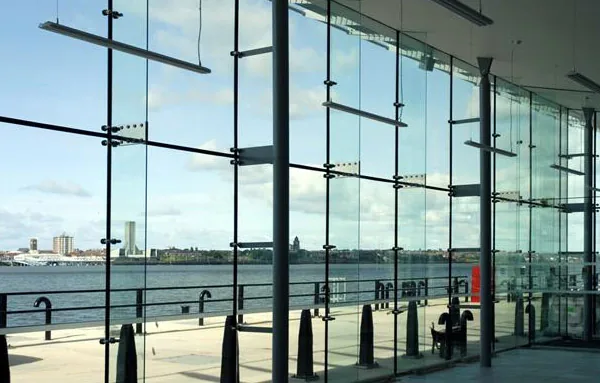
Spider glass in a commercial lobby, glass panels held only by stainless steel spider fittings, with no visible frame.
How Spider Glass Works
In a conventional glazed facade, the glass sits inside an aluminium frame that carries the load and holds it in position. In a point-fixed spider glass system, there's no frame doing that job. Instead, holes are drilled near each corner of the glass panel (or at intermediate points on larger panels), and a bolted fitting, the "spider," passes through each hole. The spider fitting's arms connect to the adjacent panels, and the whole assembly then ties back into a structural support system behind the glass.
The result is glass that spans from support to support with no metal frame on its edges or between panels. Adjacent panels are joined with a structural silicone sealant across a 10–15mm gap, a joint that all but disappears from a normal viewing distance.
Key Components of a Spider Glass System
Spider Fittings
The star-shaped stainless steel fitting at each support point, available in 2-arm (edge), 3-arm (corner), and 4-arm (central) configurations. Premium fittings rotate slightly to accommodate structural movement and thermal expansion, which matters across the UAE's wide swing in temperature between day and night. We specify cast stainless steel (AISI 316) for coastal UAE sites, where salt air makes corrosion resistance non-negotiable.
Glass Panels
Always laminated toughened glass, at minimum 2 x 8mm (17.5mm total with the PVB interlayer). If a panel cracks, the laminate holds every fragment in place instead of letting the panel collapse. Structural calculations determine the exact thickness needed for the wind loads a UAE facade will face, and larger panels at height often need to step up to 2 x 10mm or 2 x 12mm laminated glass.
Structural Support
The spider fittings tie back into a structural system behind the glass, a steel truss, a tension cable net, a portal frame, or a concrete wall. Which one is right depends on the span needed and the look you're after. Cable-supported spider glass is the most striking form of all: the glass appears to float, with nothing but slender cables holding it in place.
Where Spider Glass is Used in UAE
- Hotel lobbies and atriums, large glass feature walls and skylights in Dubai's luxury hotels
- Commercial building facades, fully transparent ground-floor retail and office frontages
- Villa feature walls, dramatic floor-to-ceiling glass walls in entrance halls, living rooms, and stairwells
- Airport and transport hubs, extensive use throughout UAE aviation infrastructure
- Retail and showrooms, high-end brand stores requiring maximum product visibility