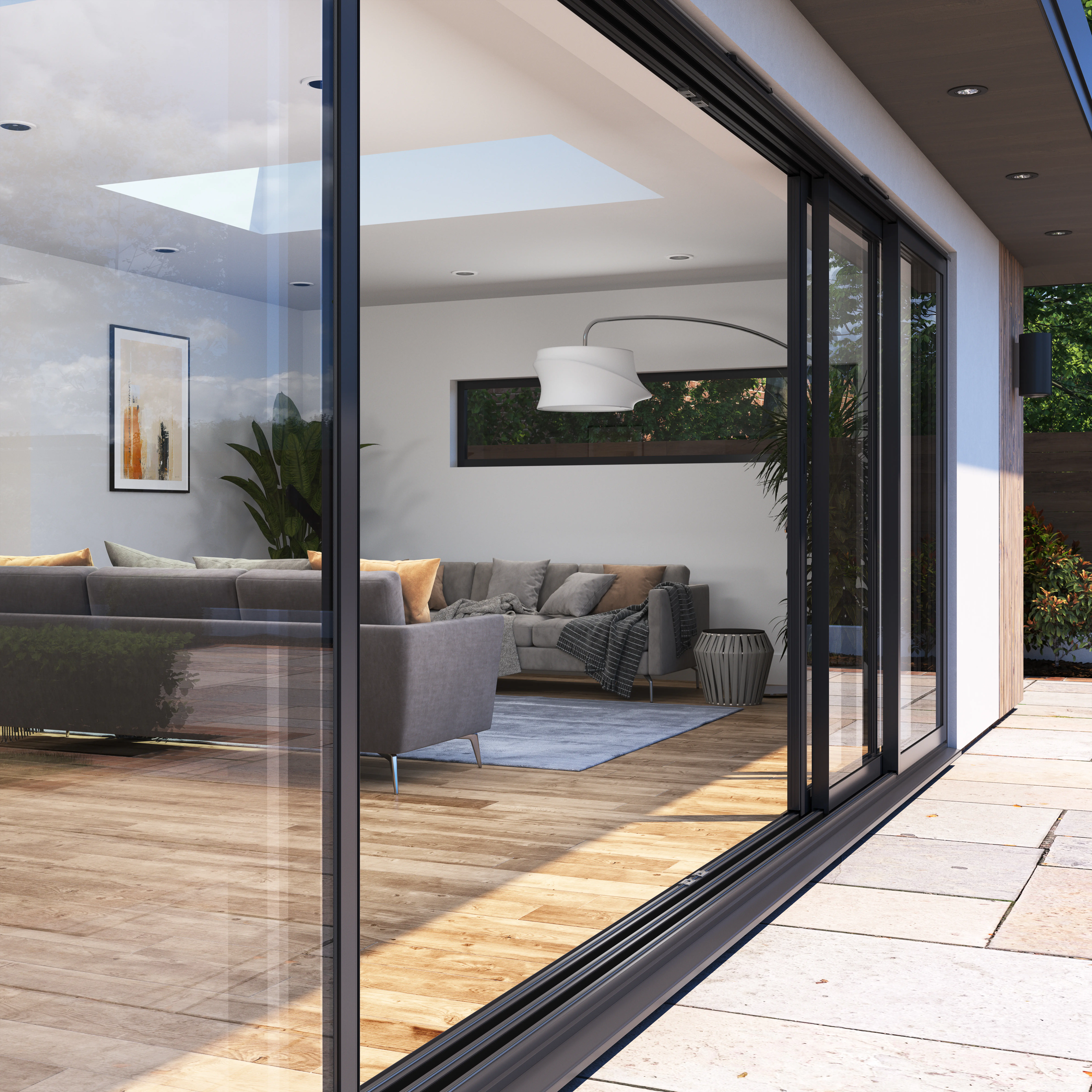
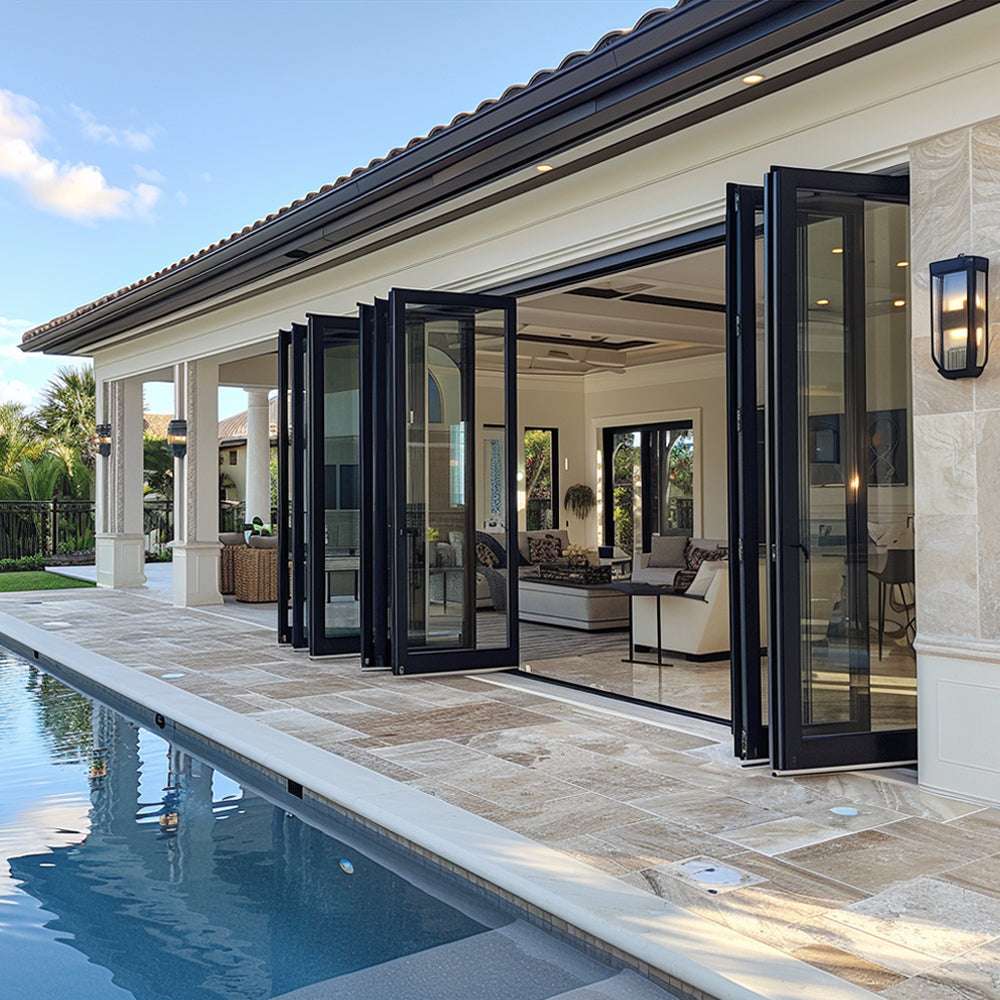
Sliding doors and bifolding doors open up a wall of glass in different ways. A sliding door moves one or more panels horizontally along a track, so part of the opening always stays covered by a panel. A bifolding door folds each panel back on itself and stacks the panels to one or both sides, opening nearly the full width of the space. Which one suits a project comes down to how much of the wall needs to disappear.
How Each System Opens
A sliding door runs on a track, with one panel (or more, on multi-track systems) sliding horizontally behind or alongside a fixed panel. Because at least one panel always sits in the track's path, the usable opening tops out at roughly half to two-thirds of the total door width, even on wide multi-track installations.
A bifolding door works on a different principle. Each panel hinges to the next and folds back on itself in a concertina motion, then the folded stack parks to one side or splits across both sides of the opening. With the panels folded flat against the frame, the opening can reach nearly the full width of the wall.
Which Suits Which Opening
Sliding doors have a lower profile and fewer moving parts than bifolding systems, which keeps the mechanism simple and the sightlines clean. This suits wide openings where the room doesn't need to be fully open to the outside, a living room with a partial view to a terrace, for example, rather than a room that needs to merge with it.
Bifolding doors suit openings built around removing the wall entirely. A living room connecting fully to a garden or terrace, where the boundary between indoors and outdoors needs to disappear when the doors are open, is the typical case. Both systems are available from Diamond Step® with security-rated glass and hardware, so the choice comes down to how the space is used rather than a trade-off in security.