Shower enclosures come in three builds: frameless, semi-frameless and framed. The difference is how much metal holds the glass, and that drives both the look and how much upkeep the enclosure needs. It is one of the most visible upgrades in any UAE bathroom renovation, the first surface you notice walking in and one of the hardest-working, dealing with hard water and humidity every day. Whether you are fitting out a new villa in Dubai or upgrading a master bathroom in Abu Dhabi, that choice shapes the room long-term.
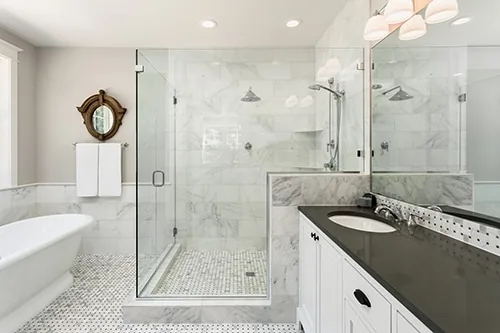
A frameless shower enclosure with premium hardware, a clean, timeless finish for any UAE bathroom.
The Three Types of Shower Glass Enclosures
Frameless Shower Enclosures
No metal channel runs around the glass panels, only discreet hinges, clamps, and a handle. The glass has to be 10mm or 12mm thick tempered safety glass to compensate for the lack of a supporting frame. Frameless shower enclosures in UAE are the most requested option in new luxury villas and hotel fit-outs, since the unbroken glass reads as clean, modern, and unlikely to date. Hardware finishes include brushed nickel, matte black, brushed brass, and rose gold.
Semi-Frameless Shower Screens
The fixed panels carry a minimal frame on the sides and top, while the door itself swings or slides without one. It's a practical middle ground, more affordable than fully frameless while still reading as refined. We see this most often in mid-range villa bathroom upgrades across Sharjah, Ajman, and the northern emirates.
Framed Shower Enclosures
Full aluminium or stainless steel channels surround every glass panel. This is the most cost-effective option and the one most widely used in apartments and budget renovations. It's easier to install and repair than a frameless system, but the metal tracks can harbour mould over time in the UAE's humidity if not cleaned regularly.
Glass Types Used in UAE Shower Enclosures
UAE building regulations require tempered safety glass for every shower enclosure. The common options are:
- Clear tempered glass (8mm, 10mm, 12mm), the standard. Clean look, maximum light, easy to clean with proper coating.
- Frosted / sandblasted tempered glass. Offers privacy, popular in shared bathrooms or ensuites with open layouts.
- Low-iron (ultra-clear) glass: no green tint, crystal clear. Premium choice for luxury bathrooms where colour accuracy matters.
- Anti-limescale coated glass, hydrophobic coating repels water and soap scum. Highly recommended for UAE's hard water supply, reduces cleaning frequency significantly.
Hardware Finishes Popular in UAE
The hardware on your shower glass Dubai installation sets the tone of the whole bathroom. The finishes we install most often on current UAE projects:
- Matte black, strong contrast against white tiles or marble, contemporary look
- Brushed gold / rose gold, warm, luxurious feel, popular in master bathrooms
- Brushed nickel / satin stainless, timeless, easy to maintain, suits all tile styles
- Chrome, traditional, reflective, most affordable
Frequently Asked Questions
Shower Enclosure Shapes: Which Configuration Is Right for Your Bathroom?
The shape and layout of your bathroom determines which enclosure configuration works. Here are the configurations we install most often on UAE projects:
- Alcove enclosure, glass on one or two sides, with the other sides being existing walls. The most space-efficient option for standard bathrooms in Dubai and Abu Dhabi apartments. A single swing or pivot door in one glass panel is typical.
- Corner enclosure, glass on two sides, forming an L-shape. Entry is via a pivot or hinged door in one of the glass panels. Very common in UAE villa master bathrooms where the shower is positioned in a corner of the bathroom.
- Walk-in wet room, a single fixed glass screen (or no glass at all, using the full room as the shower area). Increasingly popular in new luxury villa fit-outs in Dubai's premium areas. Requires a well-designed drainage gradient across the entire floor. Minimal hardware, maximum visual openness.
- Frameless walk-in panel, a fixed glass screen on one or two sides, open entry on the remaining side. Popular in larger bathrooms where a door is not necessary. Very clean appearance, minimal maintenance.
- Quadrant (curved) enclosure, curved glass panels forming a quarter-circle footprint. Common in older UAE villas where space constraints dictate a compact shower area. Not the most popular choice in modern renovations, where straight-line designs dominate.
The Shower Glass Installation Process
A shower glass enclosure looks like a straightforward fit, but the installation involves more precision than it appears. Here is what to expect when Diamond Step handles the project:
- Site measurement. We measure the shower area precisely, checking for plumb walls, level floors, and the tile finish. In UAE bathrooms, walls are rarely perfectly plumb, and we account for this in the fabrication to ensure panels fit flush without gaps.
- Fabrication. Glass panels are cut to your exact bathroom dimensions and tempered. Hardware is selected and, for frameless systems, the hole positions for hinges and handles are drilled at the factory stage. Lead time is typically 5 to 7 working days.
- Installation. Wall channels or hinges are fixed to the tiled walls using stainless fixings and a flexible waterproof sealant. Glass panels are installed and adjusted for plumb. Sealing strips are fitted at all glass-to-tile and glass-to-glass joints.
- Silicone sealing. All joints are siliconed with a neutral-cure, mould-resistant bathroom silicone. This is critical: poorly applied silicone is the most common cause of shower enclosure problems in the UAE. Diamond Step uses high-quality neutral-cure silicone appropriate for the UAE climate.
- Test and handover. The door operation is adjusted, the seals are checked, and we run water to verify there is no leakage before leaving. You receive care instructions for the glass and hardware finish.
Shower Glass and Hard Water in UAE: What You Need to Know
Dubai's desalinated water supply carries a high mineral content, mainly calcium and magnesium. As water evaporates off the glass, those minerals are left behind as white, chalky limescale deposits. On shower glass this builds up fast, and once it sets in it's difficult to remove. Here is how to manage it:
- Specify anti-limescale (hydrophobic) coated glass, a nano-coating applied to the glass surface causes water to bead and run off, dramatically reducing mineral deposits. Diamond Step recommends this coating for all UAE shower enclosures as standard. It needs reapplication every 2 to 3 years.
- Squeegee after every shower. Takes 30 seconds and prevents mineral build-up from accumulating. The single most effective maintenance habit for UAE shower glass.
- Monthly descaling. Use a mild acid-based descaler (white vinegar solution works well) on any visible limescale deposits. Do not use abrasive pads, which scratch the glass and remove anti-limescale coatings.
- Hardware care, limescale also affects hardware finishes. Matte black and brushed gold finishes are more susceptible to limescale marking than polished chrome. Wipe down hardware with a dry cloth after each use.
Permits for Shower Glass Installations in UAE
Shower glass enclosure installations are entirely internal works with no impact on the building's structure. Across all seven UAE emirates, no municipality permit is required for shower glass replacement or installation. You don't usually need to notify building management for internal bathroom works, though it's worth checking your tenancy agreement or community rules regarding contractor access.
If the wider renovation involves relocating plumbing, moving walls, or changing the floor waste position, those specific elements may need approval, but the glass enclosure itself is always permit-free. That makes shower glass one of the fastest upgrades available to UAE homeowners, typically from site visit to installed enclosure in under two weeks.