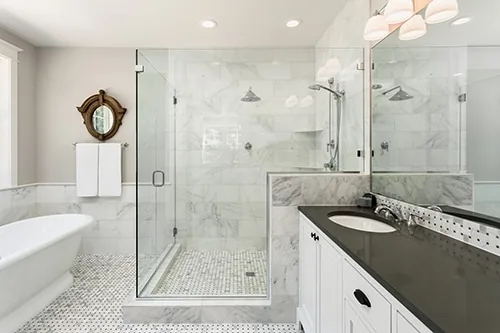
Shower glass in a high-end UAE villa ensuite is usually a wet-room partition, not a boxed-in enclosure. The shift is away from a framed cubicle with a door and towards one or two fixed frameless panels, thicker glass, and hardware finishes chosen to match the rest of the bathroom fit-out rather than a generic chrome set. This guide covers what actually changes in a premium specification: glass thickness, layout, hardware, custom sizing, and how to keep it looking new.
Why High-End Villas Are Moving to Frameless Shower Glass
A framed enclosure adds a metal channel around every edge of the glass. It's practical, but it's also the first thing your eye catches in an otherwise minimal, stone-and-timber bathroom. Frameless glass removes that channel entirely, leaving only the glass and a few discreet hinges or clamps. It's already the most requested option in new luxury villas and hotel fit-outs across the UAE, and in a high-end ensuite it's usually paired with a wet-room floor rather than a raised shower tray, so the bathroom reads as one continuous space rather than a shower boxed off in the corner.
10mm Toughened Glass: The Standard for a Premium Wet Room
All shower glass has to be tempered (toughened) safety glass. That part doesn't change for a premium job. What changes is the thickness. A standard framed enclosure typically uses 8mm glass, since the frame carries some of the structural load. A frameless panel has no frame to lean on, so it needs to be thicker on its own: 10mm is the standard for most villa wet-room partitions, stepping up to 12mm for a larger fixed panel or an unusually tall opening. Toughened glass is 4 to 5 times stronger than ordinary glass and, if it ever does fail, breaks into small, rounded granules rather than sharp shards.
Walk-In & Wet-Room Layouts vs Traditional Enclosures
A traditional enclosure is a sealed box: four panels or a door, sitting on a raised tray or upstand to contain the water. A wet room takes the opposite approach: one or two fixed glass partitions, no door, no raised lip, with the entire bathroom floor gently sloped toward a central or linear drain. Water is contained by the floor fall and the partition's position rather than by boxing the shower in.
It's a more architectural look, and it's the layout most high-end villa ensuites are asking for, but it does depend on the floor build-up being designed correctly from the start. It's a harder retrofit into an existing bathroom than a standard enclosure, so it's worth flagging early if the project is a renovation rather than a new build.
Hardware & Finish: Minimal Brackets, Brushed Brass, Matte Black
Fixings are kept to the minimum the glass thickness allows, and the finish is chosen to match the bathroom's tapware and fittings rather than defaulting to chrome. The finishes most requested on high-end villa shower glass are:
- Brushed brass: a warm finish that pairs with natural stone and timber vanities
- Matte black: the most requested finish overall, reads as a clean line against clear glass
- Brushed nickel and rose gold: used where the finish needs to match existing tapware exactly
Custom & Oversized Panels for Architect-Designed Bathrooms
A high-end villa bathroom rarely uses a standard panel size. Ceiling heights, niche cut-outs, and single oversized panels spanning the full width of a wet room are common in an architect-designed ensuite, and none of that comes off a shelf. Every panel we install is measured on site and cut to the bathroom's actual dimensions in our own workshop in Al Sajja Industrial Area, Sharjah, then installed by our own in-house team, the same in-house process behind all 400+ of our completed UAE projects, with a workmanship warranty on every installation.
Keeping Premium Glass Looking New in UAE Hard Water
The UAE's desalinated water supply is high in calcium and magnesium, which leaves a chalky mineral film on any glass surface as it evaporates. Premium extra-clear or low-iron glass isn't exempt from this. An anti-limescale, hydrophobic coating applied at fabrication makes water bead and run off rather than sheeting and evaporating in place, cutting down how much residue builds up. It needs reapplying roughly every 2 to 3 years and works best alongside a quick squeegee after every shower. For the full maintenance routine, see our guide on stopping hard water stains on shower glass.