Almost every glazing decision in the UAE is really a heat decision. The trouble is that "we use double glazing" has become a stock answer that tells a client nothing about whether their room will be comfortable in August. There are seven separate things that reduce heat through a glazed opening, they do different jobs, and one of them is regularly left out in a way that undoes all the others.
Heat Arrives Three Ways
Worth knowing, because each product tackles a different one.
- Radiation. Solar energy passing straight through the glass. This is the dominant problem here, and it is addressed by coatings and tints.
- Conduction. Heat travelling through the solid material of the glass and the frame. Addressed by cavities and thermal breaks.
- Convection. Air movement carrying heat across a cavity. Addressed by cavity width and gas fill.
A product that only tackles conduction will disappoint in a climate whose problem is radiation. That is the core reason plain double glazing, on its own, underperforms expectations in Dubai.
The Seven Levers, Roughly by Value
1. Solar control coating. A metallic oxide layer that reflects a large share of solar energy before it enters. In a Gulf climate this is the single biggest lever, because our problem is keeping heat out rather than keeping it in.
2. Low-E coating. Low emissivity: a microscopically thin metallic layer that reflects long-wave infrared. Soft coat is sputtered on, performs better, and has to sit sealed inside a double glazed unit because it is fragile. Hard coat is baked in during manufacture, is durable enough to use single glazed, and performs slightly less well. In hot climates the coating usually belongs on surface 2, the inner face of the outer pane, so it works on the heat before it reaches the cavity. The same coating on the wrong surface behaves differently, which is why a specification should name the surface.
3. The sealed cavity. Two panes with a sealed gap, typically 12 to 16mm. The cavity is what resists conduction and convection. Single glazing has essentially none.
4. Argon fill. Denser than air, so it convects less. Published figures put it around thirty percent better than an air-filled cavity, for a small addition to cost.
5. Warm edge spacer. The spacer holding the panes apart runs right round the perimeter, and a traditional aluminium one conducts heat straight around the edge of everything the coating just achieved. A structural foam or stainless warm edge closes that bridge and reduces edge condensation as a bonus.
6. Thermal break in the frame. A polyamide barrier inside the aluminium profile separating the outer half from the inner half. Aluminium is an excellent conductor, so without a break the frame carries heat through regardless of the glass. This is the one most often missing. Specifying premium glazing into a non-broken frame is the most common way a UAE glazing job quietly fails to perform.
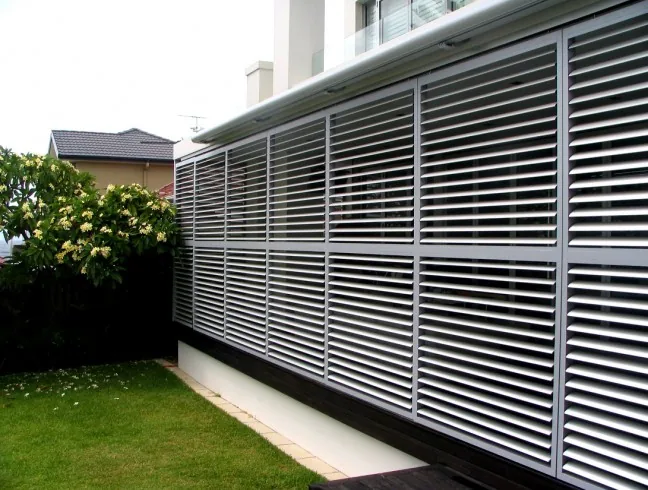
7. External shading. Louvres, a pergola, a deep reveal, a roof overhang. Stopping sun before it reaches the glass is cheaper per unit of heat than any coating, because a coating is dealing with energy that has already arrived. On a west elevation this is frequently the best value recommendation available, and it is worth asking a contractor about even though it means selling you less glass.
The Three Numbers on a Spec Sheet
- U-value, in W/m²K. How fast heat conducts through the assembly. Lower is better.
- SHGC, or g-value. The fraction of solar energy admitted, from nought to one. Lower is better, and in the UAE this is usually the number that decides comfort.
- VLT, visible light transmission as a percentage. Higher means more daylight.
There is a fourth worth knowing, because it separates good glass from merely dark glass. Light to solar gain ratio is VLT divided by SHGC, and higher is better: plenty of daylight, little heat. Anyone can lower SHGC by making the glass dark. Lowering it while keeping the room bright is what a good solar control Low-E is actually for. If a client says they want it cooler but not gloomier, LSG is the concept being described.
Realistic figures to check a supplier against
- Single glazing: U-value around 5.0 to 5.8, SHGC high
- Standard double glazed unit: U-value around 2.7 to 3.0, SHGC around 0.60 to 0.70
- Double glazed with Low-E and argon: U-value around 1.6 to 1.8, SHGC around 0.25 to 0.40
These are published typical ranges rather than a guarantee for any specific product, but they are close enough to catch a claim that does not add up. If someone quotes single glazing and claims a U-value near 2, something is wrong with the number.
What Dubai Regulation Expects
Dubai's green building system, Al Sa'fat, sets performance requirements for the building envelope, with glazing limits banded by how much of the external wall is glazed and tightening as that proportion rises. Later editions have moved toward a glazing U-value around 2.0 W/m²K with an SHGC limit near 0.25, which is among the more demanding requirements anywhere.
The figures are revised between editions, so anything going into a formal submission should be confirmed against the current document rather than taken from an article. The practical point stands regardless: on any project passing through a consultant, single glazing and frames without thermal breaks are not going to satisfy it.
A Sensible Order to Spend In
If the budget will not stretch to everything at once:
- Fix external shading first where the elevation allows it
- Then a solar control Low-E within a sealed double glazed unit
- Then the thermal break, because it protects everything above it
- Then argon and a warm edge spacer, which are inexpensive refinements to a good unit
What does not work is buying an expensive glass specification and fitting it into a cheap frame. That combination is common, and it is why plenty of UAE homeowners have paid for high performance glazing and still find the room warm.